Thursday, January 08, 2009

Flannery O'Conner on seeing and writing

"I have a friend who is taking acting classes in New York from a Russian lady who is supposed to be good at teaching actors. My friend wrote me and told me that the first month they didn't speak a line, they only learned to see. Now learning to see is the basis of all arts except music. I know a good many fiction writers who paint, not because they're any good at painting, but because it helps their writing. It forces them to look at things. Fiction writing is very seldom a matter of saying things; it is a matter of showing things."

-Flannery O'Conner in Mystery and Manners

Labels: , , ,

Wednesday, February 06, 2008

prerequisite and reward.

These are some old notes from James McMullan's High-Focus Drawing: A Revolutionary Approach to Drawing the Figure, which apparently now is out of print.

"Much of this book will deal with the issue of pleasure as a necessary part of perception in drawing."

"The pleasure was contained within the moment itself and not projected out into future hopes of praise. I had stumbled however momentarily, into the state of 'here-and-nowness' that is both the prerequisite and reward of drawing."

-John McMullan

I find that fascinating.

Can something be both a prerequisite and reward?
Is pleasure a necessary part of accurate perception?

If you believe in any kind of objective beauty, then it would make sense that love would be a part of seeing. (Leithart has a couple posts on love and knowledge: here and here.)

This also reminds me of my favorite quote from Hart's the Beauty of the Infinite:

"Thus, for Christian thought, to know the world truly is achieved not through a positivistic reconstruction of its 'sufficient reason', but through an openness before glory, a willingness to orient one's will toward the light of being, and to receive the world as gift, in response to which the most fully 'adequate' discourse of truth is worship, prayer, and rejoicing. Phrased otherwise, the truth of being is 'poetic' before it is 'rational'-indeed is rational precisely as a result of its supreme poetic coherence and richness of detail-and cannot truly be known if the order is reversed. Beauty is the beginning and end of all true knowledge: really to know anything, one must first love, and having known one must finally delight; only this 'corresponds' to th trinitarian love and delight that creates."

-David Bently Hart

After typing out that quote, I now realize that it has been wandering around in the back for a while influencing how I read things.

Labels: , , , ,

Friday, May 04, 2007

thoughts on drawing, glory, beauty and God

"When drawing the model, stay present and in utter awe! When he or she takes the stand, it is as if they are a god or goddess presented to us. They represent you and the rest of humanity. Become amazed and stay open to this fantastic occurrence. Your experience with the model is your drawing... Use the idea of having the richest and most stimulating experience drawing the model's humanity while using your very own as the purpose to drawing. All of the technique throughout the rest of this book is to serve that higher purpose."
-Mike Mattesi in Force: Dynamic Life Drawing for Animators

Drawing is seeing is knowing is loving what you see and know and draw. For we are made to know by loving, and one day seeing, the Holy Trinity, in whose image each of us and all of us are made. An image ultimately that, to quote Lewis, "...one might be tempted to worship". From the above quote : "..as if a god or goddess". As David says: "...crowned with glory and honor." For the One (and Three) we present (and re-present) as we face out into the world is crowned with an infinitely greater glory. And the whole world we face and see is also "full of his glory" as the seraphim proclaim.

Learning to draw is learning how to see the world around you. To know that each face you see is an image of God. To be borne down by the heaviness of the weight of glory. To know that speaking, spoken trees and skies are gloriously declaring glory.

And we too are words made by the Word for speaking.
We are works that work: "For we are his workmanship, created in Christ Jesus for good works, which God prepared beforehand, that we should walk in them." (Ephesians)

We are made things that make things.
We are images that make images.
We are clay that shapes clay.

And yet... perhaps drawing as I described it is not how it is now, but how it was in the old garden at the beginning of the world, and how it will be at the new garden-city at the beginning to the new heavens and new earth.

For all nature's proclamations of glory, she groans (Romans 8) under another weight, the weight of sin, the weight the King of Glory bore for us under a darkened sky on the broken tree of the cross.

"Beauty is there, abroad in the order of things..." as David Bentley Hart wrote, not in the eye of the beholder. In the eye of the beholder is a splinter or perhaps a 2X6. And so we cannot see creation or our fellow images aright. The woman God made beautifully in his image, we lust after. The brother we are given to look after, we kill instead. The glorious creation which tells of God, we mistake for God and worship.

But that is why we must go to the God who heals the blind, and pray "on earth as it is in heaven." For, as sure as the sun rises after darkness, there will come one eternal day when we will see and live with the God who opens eyes with mud and blinds men with his beauty.

Labels: , , , , , , , , , , , ,

Tuesday, February 20, 2007

looking at and looking in/through, drawing and imaging the trinity

You look at a person's ears.
You look into a person's eyes.
You look at a car.
You look into a book; through the page to the world of the book.
You look at a wall.
You look into a painting or a mirror.
And you don't look at or into lights at all, you look at everything by that light.

When you are looking at a someone and your eyes meet, touch, that is a very personal thing. If you look at someone's eyes who is not looking at you, you are looking at.

When your glances meet you are suddenly looking into each other; and that is inevitably personal, relational, and makes us vulnerable.

That is why when strangers pass each other they often look down or away that their eyes won't meet.

For in meeting, we are faced with an image of God and are aware of our need for love and to love and aware of out sin and shame.

When eyes meet, reciprocal action is required. We must give something: a nod, a smile, a wave of the hand.

Perhaps this is because we are images of the Triune God, the Father, Son and Holy Spirit, who are continually giving and receiving, indwelling, dwelling in each other, loving each other, delighting in ("beholding in joy") each other.

(When you look into someones eyes, you dwell there for a moment)

When I am drawing someone, I am usually looking at them, but if you look at a person long enough, you'll see God, an image of God. The looking at becomes looking through at some point. The same is true to a lesser extent of anything created that reveals God's glory.

This reminds me, in drawing, when you seeks the truth, fidelity to the visual universe, if you keep at it you arrive at a deeply personal (but not less objectively true) vision of what you are seeing.

Because the Triune God is at the back (and front) of everything there is, to know something objectively is also to know it personally. Truth cannot be separated from morality and beauty; Logic cannot be neatly separated from ethics and aesthetics. For when we know something, (some truth) we must act (in love) and speak the truth in love. and be (and do) what we are made for: reflect the beauty and glory of God.

Labels: , , , ,

Tuesday, January 23, 2007

Drawing and Seeing


"I have learned that what I have not drawn I have never really seen, and that when I start drawing an ordinary thing I realize how extraordinary it is, sheer miracle: the branching of a tree, the structure of a dandelion's seed puff. "A mouse is a miracle enough to stagger sextillions of infidels," says Walt Whitman. I discover that among The Ten Thousand Things there is no ordinary thing. All that is, is worthy of being seen, of being drawn."

-Frederick Franck

Labels: , ,

Thursday, August 18, 2005

On reading and seeing, and not sleeping

Time for a blog, even though there is not time.

Night before last, I was restless, I went for a bike-ride and prayed. Both good things to do when restless.

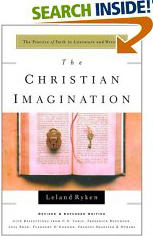
Last night I was restful, I rode my bike to the park and read"A Hedonistic Defence of literature" in the Christian Imagination edited by Leland Ryken. That is a thoroughly good book. The book to have on the subject of Christian Poetics and Aesthetics. With contributions by Lewis and Tolkien, George MacDonald and G.K. Chesterton, Flannery O'Conner and Dorathy Sayers, Brian Godawa and Peter Leithart, Francis Schaefer and Gene Edward Vieth. As well as countless others I had never heard of.

Actually I read half the essay in the bath, and half at the park. I love to read in the bath.

After that, I came home and ate some great spinach soup my mother made, then a bit later, at sunset, rode my bike to the beach (1/2 a mile away) and watched the moon and the sunset from a long pier. I like this peir, because it goes way out into the bay, about 100 yards, and turns to an L shape at the end, and their is never anyone on it in the evenings.

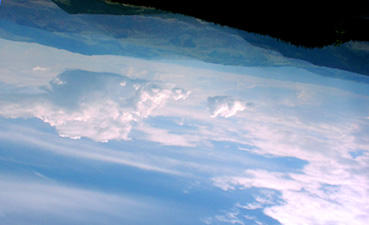
I love to lay down on the railing and put my head over the side and watch the sky upside down. If you wait a while and can imagine that you are looking down into the sky, it changes where you are. It becomes truly alien and new. (here's an image I found online and flipped over:)


I think when you do that, you can actually see the sky (or anything else) more truly, because it is unfamiliar. In learning to draw, the main work is learning how to truly see what is there by unlearning all the preconceptions and visual shorthand that our brain imposes on the world around us. One of the first exercises in any drawing class is drawing a famous drawing upside down where you don't know what it is. Only then can you truly see what it looks like instead of what it means. I also had fun looking upside down at the trees as I floated down the Guadalupe last weekend. Trees are so odd when you look at them that way, and so are splashes. Reminds me of what Tolkien said in On Fairy Stories:

"We should look at green again and be startled anew (but not blinded) by blue and yellow and red. We should meet the centaur and the dragon, and then perhaps suddenly behold, like ancient shepherds, sheep, and dogs, and horses--and wolves. This recovery fairy-stories help us to make."

Also reminds me of a Lewis quote from my favorite non-fiction work of his :
"I believe in God like I believe in the sun rise. Not because I can see it, but because I can see all that it touches. "
- the Weight of Glory

Labels: , , , ,