Thursday, January 08, 2009

Flannery O'Conner on seeing and writing

"I have a friend who is taking acting classes in New York from a Russian lady who is supposed to be good at teaching actors. My friend wrote me and told me that the first month they didn't speak a line, they only learned to see. Now learning to see is the basis of all arts except music. I know a good many fiction writers who paint, not because they're any good at painting, but because it helps their writing. It forces them to look at things. Fiction writing is very seldom a matter of saying things; it is a matter of showing things."

-Flannery O'Conner in Mystery and Manners

Labels: , , ,

Wednesday, February 06, 2008

prerequisite and reward.

These are some old notes from James McMullan's High-Focus Drawing: A Revolutionary Approach to Drawing the Figure, which apparently now is out of print.

"Much of this book will deal with the issue of pleasure as a necessary part of perception in drawing."

"The pleasure was contained within the moment itself and not projected out into future hopes of praise. I had stumbled however momentarily, into the state of 'here-and-nowness' that is both the prerequisite and reward of drawing."

-John McMullan

I find that fascinating.

Can something be both a prerequisite and reward?
Is pleasure a necessary part of accurate perception?

If you believe in any kind of objective beauty, then it would make sense that love would be a part of seeing. (Leithart has a couple posts on love and knowledge: here and here.)

This also reminds me of my favorite quote from Hart's the Beauty of the Infinite:

"Thus, for Christian thought, to know the world truly is achieved not through a positivistic reconstruction of its 'sufficient reason', but through an openness before glory, a willingness to orient one's will toward the light of being, and to receive the world as gift, in response to which the most fully 'adequate' discourse of truth is worship, prayer, and rejoicing. Phrased otherwise, the truth of being is 'poetic' before it is 'rational'-indeed is rational precisely as a result of its supreme poetic coherence and richness of detail-and cannot truly be known if the order is reversed. Beauty is the beginning and end of all true knowledge: really to know anything, one must first love, and having known one must finally delight; only this 'corresponds' to th trinitarian love and delight that creates."

-David Bently Hart

After typing out that quote, I now realize that it has been wandering around in the back for a while influencing how I read things.

Labels: , , , ,

Wednesday, May 23, 2007

Richard Wilbur on abstraction in painting and poetry

"There must be some poets who have very little visual imagination, even though the eye is the primary sense. Everybody's agreed on that. Since the middle ages I think. Even D.H. Lawrence, who made out a strong case against the primacy of vision, was a painter.
...
I think I can say why there are more painter-poets, or poets who are would be painters, than there are poets who have to do with music. It strikes me that music is infinitely more abstract then painting or poetry. That you can't make any precise statements as to what music is up to. Poetry simply has to be exact and concrete or it bores to death. And on the whole, I think--despite some successes in abstract painting-that it's the same with painting."

-Richard Wilbur, Conversations with Richard Wilbur

Labels: , , , ,

Friday, May 04, 2007

thoughts on drawing, glory, beauty and God

"When drawing the model, stay present and in utter awe! When he or she takes the stand, it is as if they are a god or goddess presented to us. They represent you and the rest of humanity. Become amazed and stay open to this fantastic occurrence. Your experience with the model is your drawing... Use the idea of having the richest and most stimulating experience drawing the model's humanity while using your very own as the purpose to drawing. All of the technique throughout the rest of this book is to serve that higher purpose."
-Mike Mattesi in Force: Dynamic Life Drawing for Animators

Drawing is seeing is knowing is loving what you see and know and draw. For we are made to know by loving, and one day seeing, the Holy Trinity, in whose image each of us and all of us are made. An image ultimately that, to quote Lewis, "...one might be tempted to worship". From the above quote : "..as if a god or goddess". As David says: "...crowned with glory and honor." For the One (and Three) we present (and re-present) as we face out into the world is crowned with an infinitely greater glory. And the whole world we face and see is also "full of his glory" as the seraphim proclaim.

Learning to draw is learning how to see the world around you. To know that each face you see is an image of God. To be borne down by the heaviness of the weight of glory. To know that speaking, spoken trees and skies are gloriously declaring glory.

And we too are words made by the Word for speaking.
We are works that work: "For we are his workmanship, created in Christ Jesus for good works, which God prepared beforehand, that we should walk in them." (Ephesians)

We are made things that make things.
We are images that make images.
We are clay that shapes clay.

And yet... perhaps drawing as I described it is not how it is now, but how it was in the old garden at the beginning of the world, and how it will be at the new garden-city at the beginning to the new heavens and new earth.

For all nature's proclamations of glory, she groans (Romans 8) under another weight, the weight of sin, the weight the King of Glory bore for us under a darkened sky on the broken tree of the cross.

"Beauty is there, abroad in the order of things..." as David Bentley Hart wrote, not in the eye of the beholder. In the eye of the beholder is a splinter or perhaps a 2X6. And so we cannot see creation or our fellow images aright. The woman God made beautifully in his image, we lust after. The brother we are given to look after, we kill instead. The glorious creation which tells of God, we mistake for God and worship.

But that is why we must go to the God who heals the blind, and pray "on earth as it is in heaven." For, as sure as the sun rises after darkness, there will come one eternal day when we will see and live with the God who opens eyes with mud and blinds men with his beauty.

Labels: , , , , , , , , , , , ,

Tuesday, April 03, 2007

quotes and links

...this is the ultimate aim of all making: to make a thing which does manifest spirit, which shows feeling, which makes God visible and shows us the ultimate meaning of existence, in the actual sticks and stones of the made thing.
-Christopher Alexander as quoted in
An Architectural Reflection on Sandra Schneiders and Philip Sheldrake’s Understanding of Christian Spirituality (This is what I was thinking about in these posts)

"The main problem with narrative in film is that when you become emotionally involved, it becomes difficult to see picture as picture. Of course, the laughing and crying and suspense can be a positive element, but it's oddly nonvisual and gradually destroys your capacity to see.
-- Michael Snow, speaking to Scott MacDonald, A Critical Cinema, Vol. 2"
Great discussion on this seeing and film at Jeffry Overstreet's blog:
Are movies increasing your "capacity to see"?

"It's his sincerity that gets Bruce Herman into trouble, the moderation of his temperament, the well roundedness of his craft. His forms are a delicate balance between abstract emotional expressions and realist figure drawings: "Some artists feel like they have to be in one of the two camps, as though there are only two—iconography or iconoclasm, realism or abstraction. And by choosing one side, they feel the need to put down the other.""

-
Bruce Herman: Painter of violent opposites

"The whole natural world, in all its glory and pain, needs redemption that will bring shalom. The world isn't divided into a sacred realm and a secular realm, with redemptive activity confined to the sacred zone. The whole world belongs to God, the whole world has fallen, and so the whole world needs to be redeemed--every last person, place, organization, and program; all 'rocks and trees and skies and seas'; in fact, "every square inch,' as Abraham Kuyper said. The whole creation is a 'theater for the mighty works of God,' first in creation and then in re-creation."

--Cornelis Plantinga - Engaging God's World (p. 96)"
-The Native Tourist

"But "Leaf by Niggle" is also about Tolkien's profoundly religious philosophy of Creation and Sub-creation. True Creation is the exclusive province of God, and those who aspire to Creation can only make echoes (good) or mockeries (evil) of truth. The Sub-creation of works that echo the true creations of God is one way that mortals honor God.

...
Niggle's yearnings after truth and beauty (God's creations) are echoed in his great painting; after death, Niggle is rewarded with the realization (the making-real) of his yearning. Or, if you prefer, Niggle's Tree always existed -- he simply echoed it in his art."

-Various Tolkien Fans on Leaf By Niggle (Tolkien's semi-autobiographical short story which deals with the relation of ethics and aethetics, as well as creation and subcreation.)

Labels: , , , , ,

Tuesday, February 20, 2007

more on looking at vrs. in, seeing, and metaphor

If we don't know how to read, we can only look at words-pretty shapes of black on white. But when we know how to read, we see through them to their meanings.

So with the book of nature. In modern times, we don't even know that nature is a book where things are written, so we weren't even looking, let alone reading.

Because nature, creation, is a thing spoken into existence, it is something that speaks. It was made by the Word, spoken by the Father, breathed out by the Holy Spirit/Breath/Wind. Creation speaks and can be read (Psalm 19).

This means that literary concepts and ways of thinking (like metaphor, analogy, and symbol etc) are natural to nature. They are there in the things of nature and in the nature of things.

So the things of this world will endure and satisfy a great deal of seeing and looking (unlike modern architecture, which stopped imitating nature). There is intricacy and detail. Like a good painting, you can let your eyes dwell on it for a long time. Like a good book, it invites your eyes to dive deep into it. It isn't flat. You can look through it and into it.

Trees and skies are like good paintings, they invite a way of seeing that is different from how a machine sees. They invite us to look into them and through them. They invite us to listen to what they say.

Labels: ,

looking at and looking in/through, drawing and imaging the trinity

You look at a person's ears.
You look into a person's eyes.
You look at a car.
You look into a book; through the page to the world of the book.
You look at a wall.
You look into a painting or a mirror.
And you don't look at or into lights at all, you look at everything by that light.

When you are looking at a someone and your eyes meet, touch, that is a very personal thing. If you look at someone's eyes who is not looking at you, you are looking at.

When your glances meet you are suddenly looking into each other; and that is inevitably personal, relational, and makes us vulnerable.

That is why when strangers pass each other they often look down or away that their eyes won't meet.

For in meeting, we are faced with an image of God and are aware of our need for love and to love and aware of out sin and shame.

When eyes meet, reciprocal action is required. We must give something: a nod, a smile, a wave of the hand.

Perhaps this is because we are images of the Triune God, the Father, Son and Holy Spirit, who are continually giving and receiving, indwelling, dwelling in each other, loving each other, delighting in ("beholding in joy") each other.

(When you look into someones eyes, you dwell there for a moment)

When I am drawing someone, I am usually looking at them, but if you look at a person long enough, you'll see God, an image of God. The looking at becomes looking through at some point. The same is true to a lesser extent of anything created that reveals God's glory.

This reminds me, in drawing, when you seeks the truth, fidelity to the visual universe, if you keep at it you arrive at a deeply personal (but not less objectively true) vision of what you are seeing.

Because the Triune God is at the back (and front) of everything there is, to know something objectively is also to know it personally. Truth cannot be separated from morality and beauty; Logic cannot be neatly separated from ethics and aesthetics. For when we know something, (some truth) we must act (in love) and speak the truth in love. and be (and do) what we are made for: reflect the beauty and glory of God.

Labels: , , , ,

Thursday, February 08, 2007

Eugene Peterson on good storytelling

"Good storytellers, by enlisting our imaginations, tease us into participation in the story they tell. When storytelling is good we pulled into a world that is both truer and larger then the one we ordinarily occupy;but it is not an alien world. (The exception is escapist entertainment that deliberately falsifies by depersonalizing and manipulating reality--horror stories, harlequin romances, pornography, propaganda.) Good storytelling involves us in what has been sitting right in front of us for years but we hadn't noticed or hadn't thought was impotent or hadn't thought had anything to do with us. Without leaving the world in which we daily work and sleep and play, we find ourselves in a far larger world; we embrace connections and meaning and significance in our lives far beyond what our employers and teachers, our parents and children, our friends and neighbors have told us, to say nothing of what is conveyed by the experts and celebrities with whom we anxiously surround ourselves."

-Eugene Peterson, pg 47-48 of Eat this Book

Labels: , ,

Monday, February 05, 2007

John Howe on seeing

"I was born with busy eyes.
It’s not my fault, it’s just the way things are.
... Don’t get me wrong, I’m not complaining, it’s just that they are hard to keep up with at times. One ends up doing a lot of explaining, usually about just what exactly the devil one is doing in restricted areas, on the wrong side of high fences or locked gates, at the top of stairwells clearly posted Not Open to Public.

... They always seem to be wandering over textures, judging light and the thickness of the air. Chasing motes and dandelion seeds, calculating the flight of birds. They are continually going astray. I never know where I’ll find them.
They’re a little shy, that’s why they skirt warily around the edges of other eyes, just in case they slip and plummet down to whatever deep waters are awaiting, but otherwise they’re fearless. No sky is too big to scan, no detail to small to focus on.
When in company, I am continually having to explain why I’m so slow. Well, I stammer, there was a statue back there, yes I know it's been there for ages and it’ll be there tomorrow, but that’s just the point. Maybe tomorrow it’ll rain, or there’ll be sun backlighting it or there’ll be different clouds. I just had to make sure I saw it properly today
...
SO much to look at, and only the two of us, they must think. So much moss on trees, so many trees in a forest, such a variety of leaves for all seasons, such endearing smile lines at the corners of mouths, such grace in hands and strides... It’s a full-time job to get all that seen. "
-John Howe

Labels: , ,

Monday, January 29, 2007

Joseph Conrad on Art and Seeing

"And art itself may be defined as a single-minded attempt to render the highest kind of justice to the visible universe, by bringing to light the truth, manifold and one, underlying its every aspect. It is an attempt to find in its forms, in its colours, in its light, in its shadows, in the aspects of matter and in the facts of life, what of each is fundamental, what is enduring and essential -- their one illuminating and convincing quality -- the very truth of their existence.
...
My task which I am trying to achieve is, by the power of the written word to make you hear, to make you feel--it is, before all, to make you see. That--and no more, and it is everything. If I succeed, you shall find there according to your deserts: encouragement, consolation, fear, charm--all you demand--and, perhaps, also that glimpse of truth for which you have forgotten to ask."
-Joseph Conrad in Preface to The Nigger of the Narcissus

This short preface is perhaps my favorite piece on the nature, aim and purpose of art.

Labels: ,

Tuesday, January 23, 2007

an anthology of quotes on seeing

"What do we see when we go outside and look at the world? Has it become so familiar to us that we pay no attention to it at all? Or perhaps when we look at blue sky do we think of the refraction of light? When we notice the sun, do we think of a nuclear furnace? When we see a fox in a zoo, do we think of what we learned in biology class about bones and organs? And beyond this, when we step back and view the world, how do we see it? Blue sky, green fields, brown earth, blue water-does this set of images mean anything at all, or is it "just the way things are"? How do we view the world?"
-James Jordan

"I looked up and saw sparrows landing on a sign. Suddenly, the whole scene became completely abstract, as though I were seeing it through nascent eyes. I realized I could remove all preconceptions about these birds. That ability was very exciting."
-Richard Vander Wende

"It was less like seeing then like being for the first time seen, knocked breathless by a powerful glance."
-Annie Dillard

"We should look at green again and be startled anew (but not blinded) by blue and yellow and red."
-J.R.R Tolkien

"And art itself may be defined as a single-minded attempt to render the highest kind of justice to the visible universe, by bringing to light the truth, manifold and one, underlying its every aspect. It is an attempt to find in its forms, in its colours, in its light, in its shadows, in the aspects of matter and in the facts of life, what of each is fundamental, what is enduring and essential -- their one illuminating and convincing quality -- the very truth of their existence.
...
My task which I am trying to achieve is, by the power of the written word to make you hear, to make you feel--it is, before all, to make you see. That--and no more, and it is everything. If I succeed, you shall find there according to your deserts: encouragement, consolation, fear, charm--all you demand--and, perhaps, also that glimpse of truth for which you have forgotten to ask."
-Joseph Conrad

"I have learned that what I have not drawn I have never really seen, and that when I start drawing an ordinary thing I realize how extraordinary it is, sheer miracle: the branching of a tree, the structure of a dandelion's seed puff. "A mouse is a miracle enough to stagger sextillions of infidels," says Walt Whitman. I discover that among The Ten Thousand Things there is no ordinary thing. All that is, is worthy of being seen, of being drawn."

-Frederick Franck

"I was born with busy eyes.
It’s not my fault, it’s just the way things are.
... Don’t get me wrong, I’m not complaining, it’s just that they are hard to keep up with at times. One ends up doing a lot of explaining, usually about just what exactly the devil one is doing in restricted areas, on the wrong side of high fences or locked gates, at the top of stairwells clearly posted Not Open to Public.

... They always seem to be wandering over textures, judging light and the thickness of the air. Chasing motes and dandelion seeds, calculating the flight of birds. They are continually going astray. I never know where I’ll find them.
They’re a little shy, that’s why they skirt warily around the edges of other eyes, just in case they slip and plummet down to whatever deep waters are awaiting, but otherwise they’re fearless. No sky is too big to scan, no detail to small to focus on.
When in company, I am continually having to explain why I’m so slow. Well, I stammer, there was a statue back there, yes I know it's been there for ages and it’ll be there tomorrow, but that’s just the point. Maybe tomorrow it’ll rain, or there’ll be sun backlighting it or there’ll be different clouds. I just had to make sure I saw it properly today
...
SO much to look at, and only the two of us, they must think. So much moss on trees, so many trees in a forest, such a variety of leaves for all seasons, such endearing smile lines at the corners of mouths, such grace in hands and strides... It’s a full-time job to get all that seen. "
-John Howe

"For John, seeing is knowing (6:40; 11:45; 14:7), and knowing/seeing the Father and Son is eternal life (John 17:3). If there is no way for us to see the Father, there is no way that leads to life. We need some way to behold Him. The good news is that there is such a way, and that the name of that Way is Jesus."
-Peter Leithart

"It gets like that with cameras on vacations...It's because you don't want to miss anything. Just seeing something counts as missing it.

The result is you don't really see anything. You either skim over it because it isn't worth taking a picture of, or you take a picture of it. When you take a picture of it you feel as if you have it forever so you don't have to really look at it. You are free to move on, looking for the next thing you can't afford to miss."
-Thomas de Zengotita

Labels:

Drawing and Seeing


"I have learned that what I have not drawn I have never really seen, and that when I start drawing an ordinary thing I realize how extraordinary it is, sheer miracle: the branching of a tree, the structure of a dandelion's seed puff. "A mouse is a miracle enough to stagger sextillions of infidels," says Walt Whitman. I discover that among The Ten Thousand Things there is no ordinary thing. All that is, is worthy of being seen, of being drawn."

-Frederick Franck

Labels: , ,

Monday, November 06, 2006

Kierkegaard on seeing nature as art


"The Reason I cannot really say that I positively enjoy nature is that I do not quite realize what it is that I enjoy. A work of art, on the other hand, I can grasp, I can—if I may put it this way—find that Archimedean point, and as soon as I have found it, everything is readily clear for me. Then I am able to pursue this one main idea and see how all the details serve to illuminate it. I see the author’s whole individuality as if it were the sea, in which every single detail is reflected… The works of the deity are too great for me; I always get lost in the details. This is the reason, too, why people’s exclamations on observing nature: It’s lovely, tremendous, etc.—are so frivolous. They are all too anthropomorphic; they come to stop with the external, they are unable to express inwardness, depth."

-Søren Kierkegaard, Sept 11 1834 (Journals and Papers, Vol 1)

In modern times, I think surely this has to do with the loss of seeing the world as the free creation of God. Seeing it and knowing that it does not have to exist, and is held in existence by him. I have another post on this here, about the feeling of exploring a beautiful computer game vrs the real world.

Labels: , , , ,

Thursday, August 18, 2005

On reading and seeing, and not sleeping

Time for a blog, even though there is not time.

Night before last, I was restless, I went for a bike-ride and prayed. Both good things to do when restless.

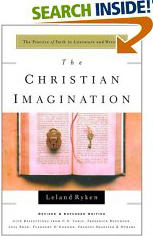
Last night I was restful, I rode my bike to the park and read"A Hedonistic Defence of literature" in the Christian Imagination edited by Leland Ryken. That is a thoroughly good book. The book to have on the subject of Christian Poetics and Aesthetics. With contributions by Lewis and Tolkien, George MacDonald and G.K. Chesterton, Flannery O'Conner and Dorathy Sayers, Brian Godawa and Peter Leithart, Francis Schaefer and Gene Edward Vieth. As well as countless others I had never heard of.

Actually I read half the essay in the bath, and half at the park. I love to read in the bath.

After that, I came home and ate some great spinach soup my mother made, then a bit later, at sunset, rode my bike to the beach (1/2 a mile away) and watched the moon and the sunset from a long pier. I like this peir, because it goes way out into the bay, about 100 yards, and turns to an L shape at the end, and their is never anyone on it in the evenings.

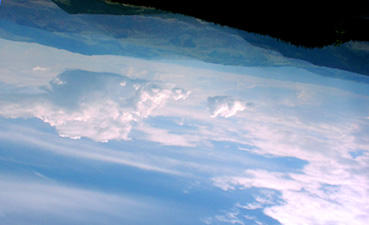
I love to lay down on the railing and put my head over the side and watch the sky upside down. If you wait a while and can imagine that you are looking down into the sky, it changes where you are. It becomes truly alien and new. (here's an image I found online and flipped over:)


I think when you do that, you can actually see the sky (or anything else) more truly, because it is unfamiliar. In learning to draw, the main work is learning how to truly see what is there by unlearning all the preconceptions and visual shorthand that our brain imposes on the world around us. One of the first exercises in any drawing class is drawing a famous drawing upside down where you don't know what it is. Only then can you truly see what it looks like instead of what it means. I also had fun looking upside down at the trees as I floated down the Guadalupe last weekend. Trees are so odd when you look at them that way, and so are splashes. Reminds me of what Tolkien said in On Fairy Stories:

"We should look at green again and be startled anew (but not blinded) by blue and yellow and red. We should meet the centaur and the dragon, and then perhaps suddenly behold, like ancient shepherds, sheep, and dogs, and horses--and wolves. This recovery fairy-stories help us to make."

Also reminds me of a Lewis quote from my favorite non-fiction work of his :
"I believe in God like I believe in the sun rise. Not because I can see it, but because I can see all that it touches. "
- the Weight of Glory

Labels: , , , ,