Saturday, September 06, 2008

Thoughts on Truth, Beauty, and Goodness #2

If truth and beauty and goodness are ultimately deeply connected; and if we are physical, emotional beings, as well as thinking ones: can we really know any truth without also finding that truth beautiful or ugly? And, on finding so, are we not moved (sometimes literally) to act on it. (to position ourselves or bodies in relation to this newfound beauty or ugliness)

And is our emotional or physical response to reality a separate thing then our intellectual response? Are they not all aspects or dimensions of the same thing?

Labels: , , , ,

Monday, September 01, 2008

old thoughts on truth,beauty, and goodness

In the end I think everything spoken that is true will be beautiful and beautifully spoken. In the end everything that is beautiful will become true; all truth, all of reality will become beautiful. Nothing can truly be true without being beautiful. And there will be no false beauty, no unreal beauty, no evil beauty, no ugly truth, and no true evil. For then all evil will be shown as ugly and banished as false. People corrupted by ugliness and evil will be beautified, remade in the perfect image of God. All that is evil will be un-made, unreal and all that is will be true, beautiful and good.

I'm not sure if this is orthodox, but it's interesting thinking about the relationship between truth beauty and goodness.

Labels: , ,

Friday, April 25, 2008

exploring game worlds and eden as a video game


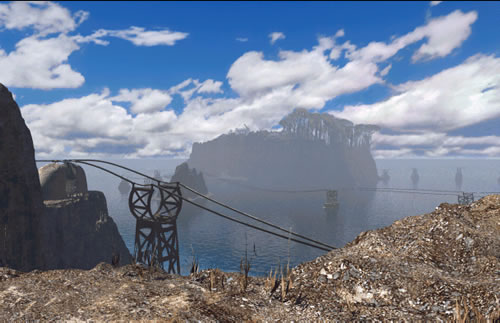
This may be obvious, but I think the difference between how we experience a beautiful computer game, (Indiana Jones and the Fate of Atlantis or Riven for example) and the way we experience our world is the relationship we have to that world. The artificial world does not have all the responsibilities that the real one does, and perhaps the newness of the format makes me see it with new eyes. Because I see a videogame as crafted, I notice and marvel at the craft.

Or is it the distance that makes it so attractive? It is that way to some degree with paintings, photos or the grass on the otherside of the fence. Is it the absence of me? Perhaps my driving force is just trying to get to a place free of me. But what is it about game worlds that is so attractive to me? In exploring abandoned buildings I get some of the same feeling. The desire to explore. What is it about horizons that so attracts us?

Relevant texts:
my post on kierkegaard and our relation to nature
C.S. Lewis' Pilgrim's Regress.
John Howe's blog post on Wanderlust

What about drawing? Does that help me get that feeling in the real world? Maybe
Or Photography? Yes and No.

Did Eden feel like an adventure game to Adam? Did life feel like a game? Was there play before the fall?

In many ways the world was like a game. Adam suddenly existed fully formed in a new world teaming with life. I suppose he had no memory. He did not yet know how this world, this life, worked, and what he was supposed to do. What the objective was. But then he was told. It became multiplayer. He got started, and then a things went south. But the games objectives didn't change. It became more complicated, but the rules and ultimate task are the same for us.

Labels: , , , ,

Tuesday, April 22, 2008

Utility and Beauty in Telephone Poles


What if telephone poles were beautiful like trees? What if they were, to borrow a phrase from Moses, a delight to the eye and good for carrying electricity. They have the utility down, but not the beauty. Cars, however, often have both. Perhaps if telephone poles were part of the consumer market they would have both. I suppose poles made from trees (like the one above) retain some of the tree's beauty that the new metal ones do not. At least they have a wonderful texture and particularity. They also have some individuality in that they are sort of put together for a specific location.


Actually, I think after looking at Bernd and Hilla Becher's photography of thousands of water towers and the like, I have come to appreciate each pole's individuality and slightly fantastic look.
Shaun Tan, who I mentioned earlier is similarly inspired by "the pattern of plumbing on the wall behind my local supermarket". I get that from drawing telephone poles.

This is one of the Becher's books, I first found out about them through the amazon wishlist of a favorite digital artist of mine, Matt Gaser, who incidentally, now has a blog. And yes, I make an attempt to stalk all my my fav. artists and authors amazon wishlists.

Labels: , , , , ,

Wednesday, February 06, 2008

prerequisite and reward.

These are some old notes from James McMullan's High-Focus Drawing: A Revolutionary Approach to Drawing the Figure, which apparently now is out of print.

"Much of this book will deal with the issue of pleasure as a necessary part of perception in drawing."

"The pleasure was contained within the moment itself and not projected out into future hopes of praise. I had stumbled however momentarily, into the state of 'here-and-nowness' that is both the prerequisite and reward of drawing."

-John McMullan

I find that fascinating.

Can something be both a prerequisite and reward?
Is pleasure a necessary part of accurate perception?

If you believe in any kind of objective beauty, then it would make sense that love would be a part of seeing. (Leithart has a couple posts on love and knowledge: here and here.)

This also reminds me of my favorite quote from Hart's the Beauty of the Infinite:

"Thus, for Christian thought, to know the world truly is achieved not through a positivistic reconstruction of its 'sufficient reason', but through an openness before glory, a willingness to orient one's will toward the light of being, and to receive the world as gift, in response to which the most fully 'adequate' discourse of truth is worship, prayer, and rejoicing. Phrased otherwise, the truth of being is 'poetic' before it is 'rational'-indeed is rational precisely as a result of its supreme poetic coherence and richness of detail-and cannot truly be known if the order is reversed. Beauty is the beginning and end of all true knowledge: really to know anything, one must first love, and having known one must finally delight; only this 'corresponds' to th trinitarian love and delight that creates."

-David Bently Hart

After typing out that quote, I now realize that it has been wandering around in the back for a while influencing how I read things.

Labels: , , , ,

Wednesday, October 03, 2007

storytelling in art history

James Gurney (author/illustrator of the Dinotopia books) has been blogging the making of the his Dinotopia paintings. In a recent post he writes about the place of illustration, animation and comics in art history, he offers these two diagrams by Dennis Nolan:

"The problem with this analysis is that it doesn’t take into consideration the forms of art that real people—like your great grandparents and my great grandparents—were excited about, namely illustration, comic art, and animation. In art history courses we never heard about these forms, nor about the artists who told stories with pictures."


"Dennis’s diagram puts the storytelling forms squarely in the center of the mainstream history of art, where they directly inherit the legacy of the ages. The modern movement still plays a significant, if culturally marginal, role as agent provocateur."

This makes a lot of sense to me. In the midst of the new mainstream I would add all film matte-painting and concept art. I've always felt that some of the stuff on say cgtalk.com or conceptart.org had much more in common with Rembrandt and da Vinci then most modern 'fine' art.

In addition to the centrality of Story-Telling that Dennis highlights, I would also add that illustration, comics etc have the following in common with traditional art most of which modernism lacks:
  • Art as Storytelling
  • Art has healthy relation to Science (Anatomy,Optics, perspective, and now physics)
  • Art as Work (commissions, making money isn't bad)
  • Art as Representation
  • Art that in some way is Beautiful
(more ramblings on this topic here)

So, perhaps modernism will only be an ugly short-lived curiosity in the final story of art.

Labels: , , , , ,

Monday, September 10, 2007

Speaking of Beauty

"Kansas can't be the only place in which a heterosexual man never uses the word beauty except to refer to a dead deer, a new pickup, or Lee Harvey Oswald's prowess with a rifle."

-Denis Donoghue, in Speaking of Beauty*

Donoghue continues:

"Even in polite society, beauty is difficult to talk about, if only because the words nearest to it are gestures, though not necessarily empty ones."

Perhaps architectural theorist Christopher Alexander knows why: "Because you cannot use the word beauty without getting actually somewhere close to the idea of God. I mean, you can use it, but not really, because you sort of shake inside when you do it and realize your at the edge of something dangerous."
-Alexander in this interview.

*If you live near a Half Price Books store, this seems to be making the clearance racks around now.

Labels: , ,

Saturday, August 18, 2007

beauty and final truth


"What Capa's photograph shows is a truth-a common, terrible, and therefore important truth. But again, does this mean the picture is beautiful? Is Truth Beauty and vice versa? The answer, as Keats knew, depends on the truth about which we are talking. For a truth to be beautiful, it must be complete, the full and final Truth. And that, in turn, leads me to a definition of beauty linked unavoidably to belief."
-Robert Adams, Beauty in Photography

I like what he says here: beauty is final truth. Beauty is eschatological truth, what all of nature groans after, the world as it should be, and as it shall be.

Labels: , , , ,

Monday, August 13, 2007

Simplicity and humility in photography

(Photo by David D, click to see flickr page)

I recently found the book Beauty in Photography: Essays in Defense of Traditional Values by Robert Adams. The title alone was enough to pique my interest, but I've heard it recommended somewhere, anyway, I just started reading it, and I highly recommend it.

"To remind ourselves of the significance of grace in photography-of the importance of seeming to do the job easily- we need only to examine a copy of a mass circulation photography magazine. Most of the pictures suggest embarrassing strain; odd angles, extreme lenses, and eccentric darkroom techniques reveal a struggle to substitute shock and technology for sight. How many photographers of importance, after all, have relied on long telephoto lenses? Instead their work is usually marked by an economy of means, an apparently everyday sort of relationship with their subject."

My friend David's photo above is a good example of the 'economy of means' Adams speaks of in this passage.

On the same subject is an essay by the late Ingmar Bergman's Cinematographer Sven Nykvist, excerpts are read in the latest Image Method Podcast. He was a strikingly humble man, though his work is outstanding. This is refreshing to see in the century of the self-deified artist.

Labels: , ,

Friday, July 27, 2007

William Whyte on the Joys of People Watching

"Whatever they may mean, people's movements are one of the great spectacles of the plaza. You do not see this in architectural photographs, which typically are empty of life and are taken from a perspective few people share. It is a quite misleading one. At eye level the scene comes alive with movement and color-people walking quickly, walking slowly, skipping up steps, weaving in and out on crossing patterns, accelerating and retarding to match the moves of others. There is a beauty that is beguiling to watch, and one senses that the players are quite aware of it themselves. You see this, too, in the way they arrange themselves on steps and ledges. They often do so with a grace that they, too, must sense."

-William Whyte in The Social Life of Small Urban Spaces

The last part of that reminded me of perichoresis, a term that the patristics used to describe the Trinity's life of mutual love and indwelling.

Labels: , , ,

Friday, May 04, 2007

thoughts on drawing, glory, beauty and God

"When drawing the model, stay present and in utter awe! When he or she takes the stand, it is as if they are a god or goddess presented to us. They represent you and the rest of humanity. Become amazed and stay open to this fantastic occurrence. Your experience with the model is your drawing... Use the idea of having the richest and most stimulating experience drawing the model's humanity while using your very own as the purpose to drawing. All of the technique throughout the rest of this book is to serve that higher purpose."
-Mike Mattesi in Force: Dynamic Life Drawing for Animators

Drawing is seeing is knowing is loving what you see and know and draw. For we are made to know by loving, and one day seeing, the Holy Trinity, in whose image each of us and all of us are made. An image ultimately that, to quote Lewis, "...one might be tempted to worship". From the above quote : "..as if a god or goddess". As David says: "...crowned with glory and honor." For the One (and Three) we present (and re-present) as we face out into the world is crowned with an infinitely greater glory. And the whole world we face and see is also "full of his glory" as the seraphim proclaim.

Learning to draw is learning how to see the world around you. To know that each face you see is an image of God. To be borne down by the heaviness of the weight of glory. To know that speaking, spoken trees and skies are gloriously declaring glory.

And we too are words made by the Word for speaking.
We are works that work: "For we are his workmanship, created in Christ Jesus for good works, which God prepared beforehand, that we should walk in them." (Ephesians)

We are made things that make things.
We are images that make images.
We are clay that shapes clay.

And yet... perhaps drawing as I described it is not how it is now, but how it was in the old garden at the beginning of the world, and how it will be at the new garden-city at the beginning to the new heavens and new earth.

For all nature's proclamations of glory, she groans (Romans 8) under another weight, the weight of sin, the weight the King of Glory bore for us under a darkened sky on the broken tree of the cross.

"Beauty is there, abroad in the order of things..." as David Bentley Hart wrote, not in the eye of the beholder. In the eye of the beholder is a splinter or perhaps a 2X6. And so we cannot see creation or our fellow images aright. The woman God made beautifully in his image, we lust after. The brother we are given to look after, we kill instead. The glorious creation which tells of God, we mistake for God and worship.

But that is why we must go to the God who heals the blind, and pray "on earth as it is in heaven." For, as sure as the sun rises after darkness, there will come one eternal day when we will see and live with the God who opens eyes with mud and blinds men with his beauty.

Labels: , , , , , , , , , , , ,

Monday, April 30, 2007

Christianity and the Arts Conference and David Taylor


Check it out! Eugene Peterson, Jeremy Begbie and others will be in Austin, April 2008 for Transforming Culture: A Vision for the Church and the Arts.

Check out David Taylor's (of the excellent blog Diary of an Arts Pastor) announcement.

While your at it check out his previous post:
Beauty Better Save this Tired World:

"The ugliness of this world, ethical or commercial or otherwise, will not be reversed by mere abstention from it, the "Christ against culture" behavior of Richard Niebuhr's analysis. It will be turned around only by gracious, generous, muscular acts of beauty.

We must act beauty out in the stuff of our lives. We must act it out even if it means looking foolish, like the very serious joker, in the eyes of a worldly wise society. We must act beauty out in order to give it a chance to reverse the imbecilic, poisonous effects of sin."

Labels: , , ,

Tuesday, April 10, 2007

Will beauty save the world? Solzhenitsyn on Dostoevsky


"So perhaps that ancient trinity of Truth, Goodness and Beauty is not simply an empty, faded formula as we thought in the days of our self-confident, materialistic youth? If the tops of these three trees converge, as the scholars maintained, but the too blatant, too direct stems of Truth and Goodness are crushed, cut down, not allowed through - then perhaps the fantastic, unpredictable, unexpected stems of Beauty will push through and soar TO THAT VERY SAME PLACE, and in so doing will fulfil the work of all three?

In that case Dostoevsky's remark, "Beauty will save the world", was not a careless phrase but a prophecy? After all HE was granted to see much, a man of fantastic illumination.

And in that case art, literature might really be able to help the world today?

It is the small insight which, over the years, I have succeeded in gaining into this matter that I shall attempt to lay before you here today."
-Alexandr Solzhenitsyn in his 1970 Nobel Prize Lecture

Why have I not read this short piece before?

Labels: , , , ,

Saturday, March 10, 2007

Hopkins and duchamp on beauty and urinals


"I threw the bottle-rack and the urinal into their faces as a challenge
and now they admire them for their aesthetic beauty.
"

-Marcel Duchamp

About a hundred years earlier poet Gerard Manley Hopkins commented on finding beauty in urinals: "...the slate slabs of the urinals even are frosted in graceful sprays."

Duchamp, because he was a modern atheist, didn't understand that we live "...in a world not vague, not lonely, Not governed by me only." (Richard Wilbur)

A world where "beauty is there, abroad in the order of things, given again and again in a way that defies description and denial with equal impertinence." (David Bentley Hart)

Duchamp, like many modernists and atheists, is confused by things like this, for disbelieving in God, he must still live in a God-made world.

Atheism would be easier and make more sense if the atheist did not live and move and have his being in God, but as things stand, he'll have to get used to inconsistencies and the surprising intrusion of beauty.

Labels: , , , ,

Sunday, February 11, 2007

Through a Screen Darkly


"I've always had this sense that there is another language I once know, a joy that was mine before I was born. When I get a glimpse of that glory though art, I can feel the memory of it pressing against the back of my mind, and the longing for that peace and resolution wells up inside me. I can't quite grasp it. I can't speak my native language. Not yet... but I'm learning.

If I do the difficult thing and pull myself away from art that is merely entertaining and start searching for those currents of truth that reside within beauty and mystery, I will be drawn off the path of familiarity and comfort. The reality of God is not bound to a particular earthly language, country or style. His spirit can speak through anything. But he is far more likely to be encountered in those things that are excellent rather than shoddy, particular rather then general, authentic rather than derivative. I will find myself investigating art and expression that never played for audiences in this country--art that waits overlooked on the shelves full of foreign and independent films at the video store. And I will be changed, concerned with cares and disciplines that make no sense to Hollywood movie publicists.

It could be a lonely road. But it's a road that leads farther up, farther in, to greater majesty and more transforming truth."


-Through a Screen Darkly by my favorite film critic Jeffery Overstreet

Do I need to say this looks like it will be a good book?

Chapter One of Jeffery Overstreet's book is available online here

Also check out his blog and his an interesting discussion of his favorite movies of 2006

Labels: , , ,

Friday, December 08, 2006

Aesthetics and Eschatology


"I came across this passage in Norman Davies' epic history, Europe, in a section analyzing the ultimate collapse of European communism. He said: 'Artists and believers were often the only people who could imagine a world without communism.' To the extent that fantasy books paint a picture of a world that is in some way more heroic, more humane, more beautiful and hopeful than this one ... that is something that people really respond to, and I'm all for it. Perhaps the number of people who are willing to wade through a hopeless and depressing book is dwindling."
-Stephen Lawhead in this interveiw

"
True art, I suggest, approximates more and more to the vision of the way things are and the way things shall be. We humans know in our bones that we are children of the present creation, which is simultaneously both glorious and shameful, and that we are designed for a fuller creation, a new order, a world flooded with the creator’s glory, full of justice and joy and, yes, beauty. The point of new creation is that it is the redemption and transformation of this present creation, with its shame and horror overcome; that is the way, if I can put it like this, to the reconciliation of Isaiah’s dilemma. And the true point of biblical apocalyptic, as opposed to the distorted and dualistic versions which have been so powerful and prevalent in our day, is that biblical apocalyptic is all about God’s future breaking in to the present, seen in glimpses, known above all in Jesus, and best expressed not in abstract theology or even in preaching but, yes, in genuine and visionary art. Apocalyptic, both in form and in biblical content, is not about the denial of the present creation, but about the overcoming of its sorrows and the realising of its promise. Apocalyptic is the key to understanding, and re-expressing, the beauty of God."

N.T. Wright in Apocalyptic and the Beauty of God, (mp3 here)

This is a sculpture Wright talks about at the end of that lecture, it's called Tree of Life and is made entirely out of "entirely from decommissioned weapons: bits and pieces of old AK47s, bullets and machetes..."
What a great image of swords beaten into pruning hooks!

Edit: From the quotes above, perhaps it's not surprising that Left Behind is aesthetically poor as well as eschatologically poor.

Labels: , ,