Wednesday, April 30, 2008

Directors Notes Podcast
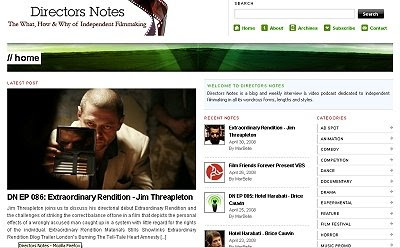

There are two types of podcasts I don't enjoy:

1. The guy in his basement ranting and rambling into low-quality computer mike
2 The over-developed, high on fluff, low on content, podcast-wanna-be-radio show.

Thankfully, Directors Notes is neither of these, with interesting, well produced content without a lot of beating around the bush.

Every week, MarBelle posts an audio interview with an independent director (mp3), a large quicktime clip from his or her film, and sometimes the script, storyboards and moodboards. The films range from feature length documentaries to 30 second animated shorts with everything in between. The interviews themselves are engaging and to-the-point, with guests from all over the world who approach film-making from many different backgrounds. The questions in the interviews are researched and specific, making for a conversation both interesting and informative. For someone who is trying to learn film-making on their own, Directors Notes is a godsend. The 85 odd archived shows are well worth downloading.

Labels: , ,

Friday, April 25, 2008

texan philosopher film-makers


I like philosophers turned film-makers who live in Texas.

Like Terrence Malick and Richard Linklater.

If I ever happen to be in the city where Terrence Malick wrote his thesis on Kierkegaard, Heidegger, and Wittgenstein, I'll have to go dig it up in the university library and have a look at it. Malick, one of my favorite film-makers is notoriously silent, never giving so much as a single interview in decades.

If you take math as a branch of philosophy you can include Shane Carruth in the list, but I guess that's a stretch.

Labels: , ,

Friday, September 14, 2007

text, image, and sound relationships

When thinking of illustrated stories, or music videos based on songs, or animated poems, what is the relationship between the various media?

Should or do illustrations merely or only serve the text of a book? I guess it depends on the book, is it a comic book, novel, or picture book.

Should the visual seek to be unintrusive, humbly self-sacrificial in serving the text?

Should one medium self-consciously contrast or harmonize with it's opposite medium producing some sort of synesthetic polyphony?

Should the visuals of a music video merely be an advertisement for the song or publicity/notoriety of the singer? (here is a good counter-example, on the right side of the page)

This is similar to the form/content discussion, but the textual,visual, and audible all have their respective contents. "Form is the shape of content"
If this is so, perhaps the images, words, and sounds are simply mediated shapes of the same 'content', though this seems too platonic. Visuals aren't simple containers for the message or meaning of a piece of artwork.

This is also similar to the form/function discussion. I like Tim Smith's “Form REJOICES in function” rather then "Form follows function."

How does this relate to film?

In film, I think we have more unity of text/image/sound then say a music video. Where do comic books, graphic novels, and children's story books lie on the spectrum?

It would also be interesting to think about the relationship of text and sound in various musical genres. For example, Country being on the content/text side of things and say, Electronica being on the sound/form side.

Labels: , , ,

Thursday, August 30, 2007

david lynch on worldbuilding in film and nature and culture

"A sense of place is so critical in cinema, because you want to go into another worl. Every story has it's own world, and it's own feel, and it's own mood. So you try to put together all these things-these little details-to create that sense of place."

"When you see an aging building or a rusted bridge, you are seeing nature and man working together. If you paint over a building, there is no more magic to that building. But if it's allowed to age, then man has built it and nature has added to it-it's so organic.

But often people wouldn't think to permit that, except for scenic designers."

-David Lynch in Catching the Big Fish

Labels: , , ,

Tuesday, June 05, 2007

Flannery O'Conner's cinematic prose

Look at this excerpt from Flannery O'Conner's short story The Life You Save May Be Your Own:

Mr. Shiftlet's eye in the darkness was focused on a part of the automobile bumper that glittered in the distance. "Lady," he said, jerking his short arm up as if he could point with it to her house and yard and pump, "there ain't a broken thing on this plantation that I couldn't fix for you, one‑arm jackleg or not. I'm a man," he said with a sullen dignity, "even if I ain't a whole one. I got," he said, tapping his knuckles on the floor to emphasize the immensity of what he was going to say, "a moral intelligence!" and his face pierced out of the darkness into a shaft of doorlight and he stared at her as if he were astonished himself at this impossible truth.

Isn't that very filmic? It may just be by obsession with film, but it seems like that's a heck of a lot of acting, directing and cinematography for a paragraph, not to mention amazing writing.

Perhaps the Brothers Coen could take on one of her stories? Their new film (an adaptation of a novel by another writer of 'southern gothic'), No Country for Old Men, looks amazing.

P.S. I listened to the O'Conner story today on Miette's excellent Bedtime Stories podcast. Kind of strange listening to rednecks read with an English accent, but she's an excellent reader.

Labels: , , , ,

Tuesday, April 03, 2007

quotes and links

...this is the ultimate aim of all making: to make a thing which does manifest spirit, which shows feeling, which makes God visible and shows us the ultimate meaning of existence, in the actual sticks and stones of the made thing.
-Christopher Alexander as quoted in
An Architectural Reflection on Sandra Schneiders and Philip Sheldrake’s Understanding of Christian Spirituality (This is what I was thinking about in these posts)

"The main problem with narrative in film is that when you become emotionally involved, it becomes difficult to see picture as picture. Of course, the laughing and crying and suspense can be a positive element, but it's oddly nonvisual and gradually destroys your capacity to see.
-- Michael Snow, speaking to Scott MacDonald, A Critical Cinema, Vol. 2"
Great discussion on this seeing and film at Jeffry Overstreet's blog:
Are movies increasing your "capacity to see"?

"It's his sincerity that gets Bruce Herman into trouble, the moderation of his temperament, the well roundedness of his craft. His forms are a delicate balance between abstract emotional expressions and realist figure drawings: "Some artists feel like they have to be in one of the two camps, as though there are only two—iconography or iconoclasm, realism or abstraction. And by choosing one side, they feel the need to put down the other.""

-
Bruce Herman: Painter of violent opposites

"The whole natural world, in all its glory and pain, needs redemption that will bring shalom. The world isn't divided into a sacred realm and a secular realm, with redemptive activity confined to the sacred zone. The whole world belongs to God, the whole world has fallen, and so the whole world needs to be redeemed--every last person, place, organization, and program; all 'rocks and trees and skies and seas'; in fact, "every square inch,' as Abraham Kuyper said. The whole creation is a 'theater for the mighty works of God,' first in creation and then in re-creation."

--Cornelis Plantinga - Engaging God's World (p. 96)"
-The Native Tourist

"But "Leaf by Niggle" is also about Tolkien's profoundly religious philosophy of Creation and Sub-creation. True Creation is the exclusive province of God, and those who aspire to Creation can only make echoes (good) or mockeries (evil) of truth. The Sub-creation of works that echo the true creations of God is one way that mortals honor God.

...
Niggle's yearnings after truth and beauty (God's creations) are echoed in his great painting; after death, Niggle is rewarded with the realization (the making-real) of his yearning. Or, if you prefer, Niggle's Tree always existed -- he simply echoed it in his art."

-Various Tolkien Fans on Leaf By Niggle (Tolkien's semi-autobiographical short story which deals with the relation of ethics and aethetics, as well as creation and subcreation.)

Labels: , , , , ,

Sunday, February 11, 2007

Through a Screen Darkly


"I've always had this sense that there is another language I once know, a joy that was mine before I was born. When I get a glimpse of that glory though art, I can feel the memory of it pressing against the back of my mind, and the longing for that peace and resolution wells up inside me. I can't quite grasp it. I can't speak my native language. Not yet... but I'm learning.

If I do the difficult thing and pull myself away from art that is merely entertaining and start searching for those currents of truth that reside within beauty and mystery, I will be drawn off the path of familiarity and comfort. The reality of God is not bound to a particular earthly language, country or style. His spirit can speak through anything. But he is far more likely to be encountered in those things that are excellent rather than shoddy, particular rather then general, authentic rather than derivative. I will find myself investigating art and expression that never played for audiences in this country--art that waits overlooked on the shelves full of foreign and independent films at the video store. And I will be changed, concerned with cares and disciplines that make no sense to Hollywood movie publicists.

It could be a lonely road. But it's a road that leads farther up, farther in, to greater majesty and more transforming truth."


-Through a Screen Darkly by my favorite film critic Jeffery Overstreet

Do I need to say this looks like it will be a good book?

Chapter One of Jeffery Overstreet's book is available online here

Also check out his blog and his an interesting discussion of his favorite movies of 2006

Labels: , , ,