Friday, December 16, 2005
Thursday, February 15, 2007
my first (and so far only) foray into worldbuilding


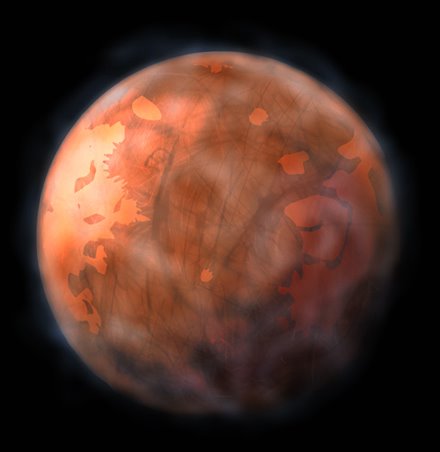
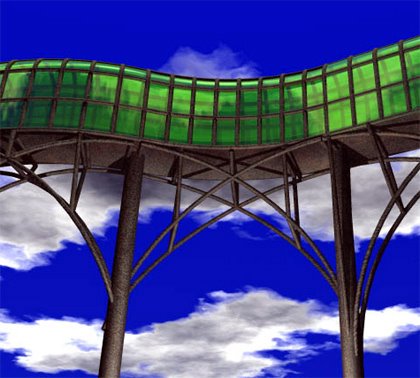
My interest in worldbuilding and storytelling, my love of reading and drawing and my desire to be a film maker all go back to an old computer game called Myst. These are some images of a myst inspired world I made about 6 years ago.
See more images of Vynclif here in this post at my sketch blog.
Here are my myst related blog posts.
Labels: myst, vynclif, worldbuilding
Thursday, November 18, 2004
Thoughts on Interactive 'art' and storytelling.
Adventure games (like myst) are, in a way, interactive stories. Which is sort of a paradox. But, then again, that is what our lives are. It like playing with providence and free will. It will be interesting to see how this medium develops. It seems to be the least popular form of video game these days.
Playing a good adventure game is really like looking at a beautiful painting, listening to good music, watching a movie, and solving a puzzle or a mystery all at the same time. Maybe one of the reason people avoid the genre is because it's sort of inbetween video games and movies or books. When people play 'games' they wnat action, when they watch movies, they don't want to have to think, and make decisions.
Anyway, I was just thinking that I would buy an old computer so that I can always come back and play all the old adventure games that are now impossible to play. I guess that's the difference between art and entertainment. Art is forever. Entertainment is meant to be consumed. And the lines are blurred in our society.
Just because the Arts of Film and Interactive entertainment began in "Consumer" society, doesn't mean that they are destined to be less then high art. Maybe....
___________________________________________
I wrote that yesterday, odd thing though, today I stumbled across this: www.99rooms.com Which is a great example of interactive art. The first word that comes to mind is Odd. A little frightening, and strangely beautiful. (warning, this site may be unsettling to some visitors)
This week I've been listening to The Count of Monte Cristo on tape while I ride my bike, or work on my projects. Listening to a book instead of reading it is a very interesting experience. It is really storytelling, as you are actually listening to someone tell you a story. I think every reader should occasionally listen to a book. Very enjoyable.
The odd thing (I say that alot now, don't I) about listening to portable cd/mp3/tape players is that the music or voice is totally disconnected with the person and performer. So I have a voice in my head telling me about Edmand Dante while I'm waiting at a stoplight on my bike or drawing or checking out a library book. Same with music.
There are so many things that technology has brought up that need to be addressed! Our culture has changed so much in the last 100 years!
Oh, by the way, I found that 99rooms link from http://www.coffeehouse-at-end-of-days.com/ What a great blog. He regularly talks about games too, though not adventure games.
Well, I'm off to do something else... Maybe I'll goto Barnes and Noble or something...
Wednesday, May 31, 2006
Flannery O'Conner against gnosticism

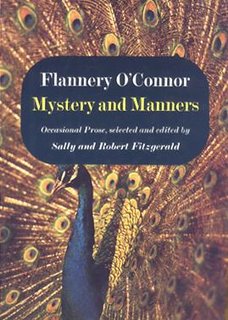
I’ve been reading Flannery O'Conner's The Nature and Aim of Fiction. (in Mystery and Manners.) Very thought provoking and engaging.
She says: "People have a habit of saying, "What's the theme of your story?" and they expect you to give them a statement: "The theme of my story is the economic pressure of the machine on the middle class"-or some such absurdity. And when they've got a statement like that, they go off happy and feel it is no longer necessary to read the story."
Reminds me of people who used to brag about their ability "to 'beat' Myst (or the like) in 10 min!" I have this awesome dvd player that lets me watch a 2 hour movie in 2 minuets! But that just goes to show how different Myst was from most computer games and why it appealed so much to non-gamers. Back to Flannery...
"Some people have the notion that you read the story and then climb out of it into the meaning, but for the ficiton writer himself the whole story is the meaning, because it is an experience, not an abstraction."
Some people here could refer to a lot of modern evangelical Christian artists, or any artist or writer who cares more about ideas then people or loves theology more then God.
"They are conscious of problems, not of people, of questions and issues, not of the texture of existence, of case histories and everything that has sociological smack, instead of with all those concrete details that make actual the mystery of our position on earth."
Wednesday, December 28, 2005
world building and story telling
And of course God made first the world and then directed his-story within that world. Come to think of it, history is really a journey from one world, an incomplete and local garden world, through a fallen world with deserts and towers of Babel, to a redeemed, complete and mature garden-city world; and in this story, we the characters are sub-creators and co-creators with God, part of the plot of The story is world-building, his world-building and ours, as we spread the garden over the world and build the holy city. It's Glorious! ... and that of course is the point: "The chief end of man is to glorify and enjoy God."
Reminds me of the Myst novels and 'games', whose stories are mostly about world-building its self. The D'ni were a culture who wrote books describing and in a way creating worlds that could then be 'linked' to and actually visited.
Umberto Eco has this to say on the topic:
"I discovered, namely, that a novel has nothing to do with words in the first instance. Writing a novel is a cosmological matter, like the story told in Genisis... What I mean is that to tell a story you must first of all construct a world, furnished as much as possible, down to the slightest details. If I were to constuct a river, I would need two banks; and if on the left bank I put a fisherman, and if I were to give this fisherman a wrathful character and a police record, then I could start writing, translating into words everything that would inevitably happen. What does a fisherman do? He fishes (and thence a whole series of actions, more or less obligatory). And then what happens? Either the fish are biting or they are not. If they bite, the fisherman catches them and goes home happy. End of story. If there are no fish, since he is a wrathful type he will probably become angry. Perhaps he will break his fishing rod. This is much; still, it is already a sketch. But there is an Indian proverb that goes: "Sit on the bank of a river and wait: your enemies corpse will soon float by." And what if a corpse were to come down stream-since this possibility is inherent in an intertextual area like a river? We must also bear in mind that my fisherman has a police record. Will he want to risk the trouble? What will he do? Will he run away and pretend not to have seen the corpse? Will he feel vulnerable, because this, after all, is the corpse of the man he hated? ...As you see, as soon as one's invented world has become furnished just a little, there is already the beginnings of a story. There already is the beginning of a style, too, because the fisherman who is fishing should establish a slow, fluvial pace, cadenced by his waiting, which would be patient but also marked by the fits of his impatient wrath. The problem is to construct the world: the words will practically come on their own. Rem tene, verba sequenture: grasp the subject and the words will follow. This, I believe, is the opposite of what happens with poetry, which is more a case of verba tene, res sequentur: grasp the words, and the subject will follow."
-Postscript to the Name of a Rose
Thursday, November 20, 2008
a rough chronology of obsessions
reptiles
islands
treeclimbing
treehouses
hardy-boys
treasure hunts
adventure games
computers
starwars
myst
film music
bryce
riven
textures
lord of the rings
dostoevsky
leithart
concept art
matte painting
beauty
drawing
trees
poetry
theology
seeing
worldbuilding
cathedrals
interactive storytelling
cinematography
film-making
books
visual storytelling
truth, beauty and goodness
trinitarian aesthetics
nature/culture
worldbuilding as storytelling
Sunday, October 08, 2006
Lewis says (speaking about him and his brother in there childhood):
"We never saw a beautiful building nor imagined that a building could be beautiful."
Now that is patently false for anyone born in the 1800's in europe. Ugly architecture, like florescent lights, and atomic bombs, wasn't invinted untill the 20th century! Living in 20th century America I would say that he never saw an ugly building nor imagined that a building could be so butt-ugly.
Also this:
"I am the product of long corridors, empty sunlit rooms, upstairs indoor silences, attics explored in solitude, distant noises of gurgling cisterns and pipes, and the noise of wind under tiles. Also, of endless books."
That pretty much somes up why I love myst, riven and adventure games in general. It's fitting that the brothers miller were Lewis fans.
Monday, September 18, 2006
Nature and Culture
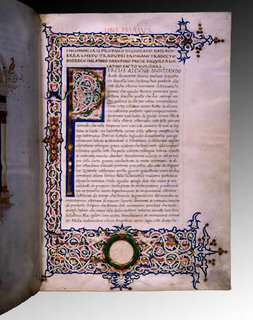
I just finished reading this excellent short book on the making of medieval books. Reading this book (and reading Umberto Eco's the Name of the Rose, and playing the Myst games...) makes me want to make a book before I die. Perhaps copy out favorite poems or a book of the Bible, over the course of several years in my spare time. Anyway, here's a quote that struck me:"But the reason for the shape (of illuminated manuscripts) is because animals are oblong, and the reason why books even today are taller then they are wide is because in there medieval ancestry there was a millennium when they were made from folding animal-shaped parchment."
This made me think about the relationship between nature and culture. Christianity understands culture to be natural and nature to be cultural, because God ordained culture at the end of his creation of nature, and also creates and inspires works of culture. In addition to the book of nature he wrote through the hands and words of men a great book. He gave plans for the construction of buildings like the temple. These are works of human culture, but by the maker of nature.
Also Eden was a cultivated garden, as the whole world is (and was) supposed to me. "The Bible begins with a garden and ends with a garden-city"as David Hegeman says in his excellent book on a Biblical Theology of Culture. This is something about nature that environmentalists never seem to understand. Trees weren't meant to be alone. They need to be trimmed and groomed and looked after. Nature isn't nature without culture. At the same time culture flows from nature.
Friday, September 15, 2006
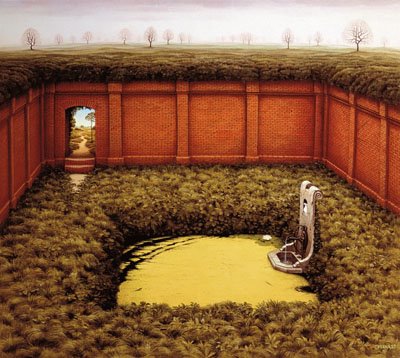
Jacek Yerka
I just discovered this wonderful artist from the Lines and Colors blog. Check out his website here. This image called Jesien, reminds me of This place from Riven:

Alot of his work seems to be in the same sort of worlds as Myst and Riven, and near perhaps some of the Narnia worlds and Harry Potter worlds.
It seems the surrealism I like usually has nothing to do with perspective tricks, etc (like Escher, as much as I like his work) I like rather a world that takes reality and twists it slightly, giving the adjectives of one thing to something completely different (as tolkien describes fantasy), all while remaining plausible. Much of Jacek's work has this quality and a few pieces are more like pop surrealism. I guess it's the difference between a fully detailed world building and simple optical illusions.
The difference between his surrealism, and say Dali's is the difference between a nightmare and a dream, you might say. It's a world you want to go to.
Tuesday, August 29, 2006

Cool new book, unfortunatly they left out the D'ni language of the Myst books and games. That's pretty big to be left out of a book like this.
Saturday, July 08, 2006
a new rating

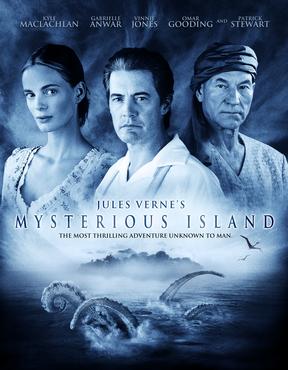
Last night, my siblings and I rented Mysterious Island, because it's the Verne novel that helped inspire Myst, and it has Patrick Stewart and a giant squid on the front. (both of which are fairly cool) Turns out it is merly a coincidence that it as the same name as the Jules Verne novel, and no giant squid. The other actors were so bad that it offset Patrick Stewart's goodness. Plus most of the special effects were sub christian action movie quality.
So, in the spirit of Cockeyed Pranks, and to warn the people wandering through blcokbuster, I made this in photoshop for the back:

Before:

After:

Now I have to return it to blockbuster.
Wednesday, May 31, 2006
of this and virtual worlds
This evening as I took a walk in the puddles of our neighborhood, I was puzzling about why it is that I don't get the same pleasure from the 'realistic' visuals in our world as I do from realistic worlds in computer games like Myst and Riven or to some degree parts of Half-Life 2.
Sometimes I think "If only I could think that this was a computer game, how much pleasure I would get from it, how much fun I would have!" I do love the beauty of creation, but it seems to be a different sort of pleasure that I get from virtual worlds. Perhaps it is simply knowing that they are not real while they seem so magically real.
Or perhaps I too often don't think of the real world as a world brain-stormed, designed, and created to be incredible detailed and...realistic. Perhaps I don't think enough that this world is something that did not have to exist made by someone for the mere pleasure of the people who wander through it.
I think it is when I realize how unnecessary the detail in the world is, I most enjoy it.
I don't know.
Wednesday, April 05, 2006
Storytelling and Worldbuilding in Disney Land

"Stories are about order and control: first one thing happens and then another. So are poems and novels and films -and so is art for that matter. At Disneyland, Walt translated that verbal and pictoral narrative into a material, spacial dimension. He made a city, or a series of cities, that told a story, as a king or his visionary architect might do in drawing up a master plan for a loveley pleasure garden. First comes the fountain. Then, the statue. And then, the castle."
-Karal Ann Marling in Designing Disney's Theme Parks
It seems I never read books until I sell them or they are over due. I just sold this one, so I am scanning through it. Very interesting. Reminds me of Robyn Miller describing Myst and Riven as sort of their version of Disney Land. Storytelling through Worldbuilding. That's what I want to do.
Saturday, November 05, 2005
Or something.
Anyway, I painted in painter for a while and ended up making this, which is better then normal for just playing around:

Whenever I had that creative urge in the past, I would work on Vynclif, a myst-inspired world I worked on for a couple years until my computer crashed. This was 3D world, not painting, so all that remains are a few renders I put on the internet.


After that I decided to learn to draw, and that's what I've mostly been doing the last few years, but it get's boring and I'm not to the level where I can really create, I mostly just draw what I see. Some day.
In a way, everything I do, drawing, photography, painting, 3d modeling, reading books on film-making or storytelling or aesthetics or theology, has been an attempt to someday be able to really make something, to sub-create, to build a world with it's places, cultures, histories, and people, and one day tell some sort of story there.
Thursday, June 30, 2005
A small world, Robyn Miller, and the Nature of Order
Speaking of which, Robyn Miller has an excellent blog on all things odd and aesthetically interesting. He's the creative mind behind Myst and Riven, and has always been something of an 'idol' for me. One of his latest blog entries is on Theo Jansen's wooden creatures (powered by the wind) that stroll beaches in herds. Be sure to check out the videos: http://www.strandbeest.com/
I also found in my nightly procrastination, a very interesting architect named Christopher Alexander who wrote 4 books in a series called the Nature of Order:
The Phenomenon of Life
The Process of Creating Life
A Vision of a Living World
The Luminous Ground
If the weren't so expensive, I'd buy them for their elegant covers and interesting titles alone! But seriously, they look incredibly interesting. He seems to be something of a theist, given this quote:
". . . I believe he is likely to be remembered most of all, in the end, for having produced the first credible proof of the existence of God . . ."
Probably not a Christian, but still. Here's a quote from the overview of book 4
"The book begins with a critique of current cosmological thinking, and its separation from personal feeling and value. The outline of a theory in which matter itself is more spirit-like, more personal in character, is sketched"
He seems to be longing for the Trinity, and for the accurate view of the world, where Persons and not things or stuff is most fundamental and basic. In the summary of book 1 it says:
"Starting with an analysis of the arbitrariness of present-day architecture.." That also is comforting. Modern architecture and its daughter Post-modern architecture are arbitrary because they are based in an arbitrary philosophy, where knowledge is based in an arbitrary arrangement of bits of information and matter. In truth, thankfully knowledge is grounded in personally knowing the Trinity who created everything; And nothing in the universe is arbitrary. In an amazon review of the 2nd book the reviewer says
"The processes of nature can make an infinite number of human faces, each one unique, each one beautiful. The same is true for daffodils, streams, and stars"
Wow! That is the one and the many, the infinite originality, the old newness of our God! Processes of nature, baloney!
Thursday, June 23, 2005
Abandoned Places

http://www.abandoned-places.com/
I love to exploring strange places. Unfortunately most places I've been only through the computer. But then again, that's better then not at all.
Through adventure games I've explored The Titanic on her maiden voyage, Atlantis, the worlds of Myst and Riven, and parts of London and ancient Rome. Great Fun. I would love to explore some real places some day though. Urban exploration is probably the only illegal thing I've only really wanted to do.
Monday, November 29, 2004
The Brothers Miller
Recently I've been reading Ryan Millers blog. Younger brother of the Rand and Robyn Miller who made myst. Interesting.
Also here's an interesting article about Robyn Miller, who may well me my favorite author/artist/musicion/film-maker/etc. today
Heres a quote:
"The Christ story is a myth I believe is true, and is incredibly compelling,"
Miller says. "It's become dulled in our imaginations, but if we could listen to
it for the first time - a god who has a son who becomes a man, who makes the
supreme sacrifice - it's still very alive." .....
For Miller, precision in a
work of art is more than a reward unto itself - it's a tribute to the author of
authors, whose trademark is the .sig file of all things. "Whether you're making
cabinets, designing software, or writing an article, I believe that God would
have us make things well, and act creatively in every scenario, because that's
what He does and we're made in His image."
Some good pics of riven can be found here:
Looking back on my life so far, Robyn miller really has been very influencial in my interests, tastes and goals. So I'll post somemore interveiws:
http://members.aol.com/jamesstep2/robyn/robyn1.html
http://www.wired.com/wired/archive/5.09/riven_pr.html
and one with his brother Rand: http://www.cornerstonemag.com/imaginarium/features/rand.html
And then a link to Richard Vander Wende's site , who worked closely with Robyn on Riven:
www.vanderwende.com
P.S. Please comment, I'd love to know what yall think.